Click below for a pdf of the Artist Statement:
http://art.ku.edu/people/pdf/Shawn%20BitArtist Statement
In the mid-nineteenth century eight families met Mormon missionaries in northern Europe. These families, each pulled by the desire to live in a holy utopia, left their ancestral lands. Landing in New York, New Orleans and San Francisco they packed up wagons and walked to the Utah Territory. Sheltered in old customs and engaged with a new environment they slowly settled into the Rocky Mountains. Over a century later, I inhabit their collective skin and look at the present through the filter of the world they helped create in the desert mountains.
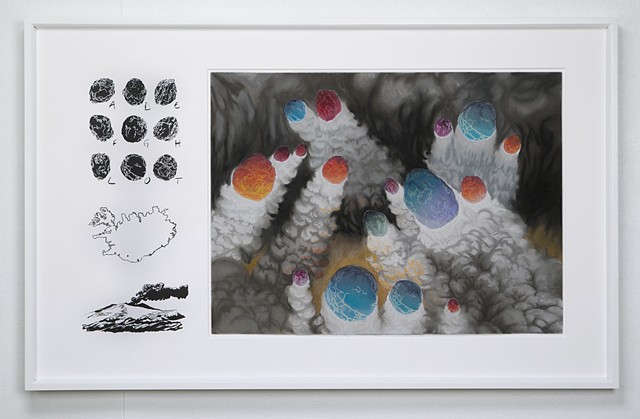
Barry Lopez in his book Arctic Dreams states his belief that ones native environment physically shapes ones mind. Since I have left the desert mountains that originally shaped my thoughts, I have been working to define my connection to my past and present landscapes with a multiplicity of media. I use geology and the body to discuss the present nature of the past. These physical elements become storytellers, presenting narratives and metaphors for my relationship to space and place.
Printmaking, papermaking and photography have been key in realizing my work. In choosing processes, I aim for a melding of media, content and concept. Through printmaking and papermaking, I create paper sculpture and installations that present constructed personal landscapes. Photography is an elegant choice for documenting my bodys direct engagement with a given landscape. It brings spontaneity and a performative aspect to my creative process.
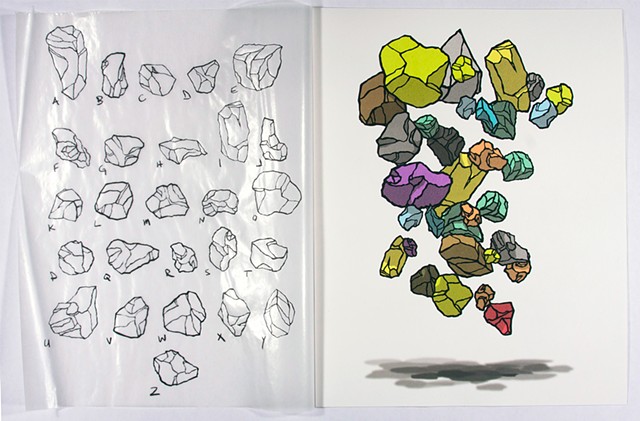
Recent work is preoccupied with how we use stories and language to form a connection to land. We use stories to shape unknown environments into understandable landscapes. Landscapes are mental constructions: they are an assemblage of elements and relationships that are understandable and familiar. When encountering a new environment there is always an element of fear of the unknown. However, once a newcomer connects a story to the location, be it a personal experience, a historical anecdote, or a scientific theory, the location becomes understandable. This new understanding, in the mind of the newcomer, transforms the environment into a landscape. This process is a part of the migration experience. Stories of better places draw people in search of them or cause them to pine for landscapes left behind.
In the short story Signs & Symbols by Vladimir Nabokov, there is a striking example of assigning a language to nature. In this story, a character believes that nature is communicating directly to him through the arrangement of clouds, a network of branches: in everything he sees. Mankind has a long history of reading nature, whether through soothsayers, prophets, or scientists. It is a short step from understanding how a certain environment works to thinking that the environment is communicating with us. By assigning nature a voice and a language, we are lending it human characteristics or, in other words, personifying nature. I am fascinated with the transition between understanding nature and personifying nature. The urge to lend our own thoughts and characteristics to the physical phenomena that shape our environments is irresistible because the result is to render them understandable.